
An Overexplainer’s Corner of the Internet
A Note Before You Read
I’ve been staring at something on my wall.
It’s been there for a few months now, and if you walked into my living room you’d probably notice it immediately — it doesn’t exactly blend in. But life moves fast, and I’ve been moving with it, and somewhere in all that forward motion I never really stopped to ask myself what it meant that I put it there.
This blog has always been about the past. I don’t usually write about the present, and I almost never write about the future. But this thing on my wall keeps pulling me in both directions at once, and I finally had to sit down and figure out why.
This is me figuring out why.
_________________________________________
There is a saddle on my wall.
Not tucked in a corner. Not draped in a blanket. Not hiding. It’s on the wall in my living room, in the first real home I’ve ever shared with my husband, in plain sight — where I can see it every single day.
I hung it there on purpose.
It took me fifteen years to get here.
Prima Donna
prima donna /ˌprēmə ˈdänə/ Literally: the leading female singer in an opera company. Figuratively: a temperamental, vain, or arrogant person who demands special treatment, considers themselves more important than others, and is difficult to work with. Origin: Italian. Literally, “first lady.” In everyday use: the coworker who demands constant praise, refuses to do the unglamorous work, and acts like the rules were written for other people.
I was called a “prima donna” when I was about seven or eight years old.
I did not know what that meant. I had never heard the word in my life, and yet somehow — standing in a barn with a broom in my hand, hovering over a dustpan with my fingers suspended in midair — I knew instantly it was not a compliment.
It was dirty. That was my full explanation. The dustpan was dirty and I did not want to touch it with my bare hands.
My horse trainer walked past, caught me mid-hover, and said it with a laugh that somehow made it worse: “Oh, look at this prima donna over here, doesn’t want to get her hands dirty!” She lived on the property and she did not soften things. Horses don’t care about your feelings, and neither did she. You show up ready or you don’t show up. You do the hard thing first and you earn the beautiful thing after.
I tucked the embarrassment somewhere quiet, finished my chores, and didn’t say anything.
But something stayed with me from that moment. Not just the shame of being called out — though that stung more than I knew how to say. It was the realization that I had walked into that barn expecting the beautiful part. The riding, the connection, the wind-in-your-hair version of horse life I’d seen from the outside. I didn’t fully understand yet that the beautiful part costs something. That everything worth having does.
The farm was about to teach me that lesson whether I was ready for it or not.
The Beautiful Lie
Before my family ever owned the farm, I was a visitor there.
My grandfather had horses. A distant cousin was a trainer. I’d been led around on horseback as a small child and fallen completely in love with the whole world of it — the smell of hay and leather, the sheer size of them, the feeling of being trusted by something that much bigger and stronger than you. When my parents found the farm and I started riding there before we ever moved in, I got to experience it the way most people do: as a guest.
Being a guest at a horse farm is a beautiful lie. You show up, the work is already done, the horses are already tacked, and the people running it make everything look effortless. I watched the trainer move through that barn like she owned every inch of it — calm, capable, completely unbothered — and I thought that was just what horse life looked like. Wind in your hair, horse beneath you, the most photogenic version of yourself cantering into the afternoon.
And then my parents bought the farm and we moved in.
And I found out what it actually looked like from the inside.
The rule was simple and non-negotiable: if you want to ride, you earn it before and you earn it after. You groom the horse, you tack up, you ride, you untack, you groom again. You sweep the floor. The barn doesn’t clean itself and the horse is not a theme park attraction. That was the deal.
I swam. Badly, at first. But I swam.
What It Actually Costs
The farm didn’t just teach me about horses. It taught me about the actual cost of things.
No sleeping in. No real breaks. No summers that belonged to you. My parents were trying to make a living off the land, which meant I got to watch them work in a way most kids don’t — the daily grind of keeping something running, what it looks like when adults are building something real and it is hard and they do it anyway.
I remember one winter night when an ice storm came through and my dad got a call — horses loose on the road in the dark and the cold. We layered up fast, half-asleep and stumbling, and went out into it. After that night we kept our barn clothes fireman-style by the door. Layers ready. Boots you could step straight into. Because when something needs you, it doesn’t wait for you to feel ready.
I absorbed all of it. Not consciously. Not in some dramatic moment of transformation. Just slowly, through years of being asked to do the hard thing anyway, something in me shifted. I stopped hovering over the dustpan. I stopped waiting to feel ready. I just did the thing because the thing needed doing.
And somewhere in the middle of all of that — somewhere between the ice storms and the unglamorous labor and the years of showing up — my dad bought me a saddle.
I want you to understand what that meant.
I had been riding horses for years by then, borrowing other people’s equipment. Borrowing tack, borrowing saddles that didn’t quite fit right, making do. My parents were building something real and it was hard and horse equipment is expensive — saddles can run anywhere from five hundred dollars to several thousand depending on the type, the fit, the quality. It wasn’t something we just went out and bought.
But one day, my dad bought me one. Mine. With my name attached to it in every way that mattered.
I remember running my hands over it — the leather worn smooth in the right places, the weight of it real and solid in a way that borrowed things never quite feel. It fit. Not just physically. It fit like something that was always supposed to be mine and had finally found its way to me.
It was the cherry on top of everything the farm had already given me. I had worked for it, literally — trading barn labor for riding lessons, showing up and earning it the hard way, the only way it means anything. And then my dad handed it to me and it was like he was saying: I see you. I see the work. You belong here.
I didn’t have the words for it then. I do now.
Twister
His registered name wasn’t Twister. But that’s what we called him, and that’s who he was.
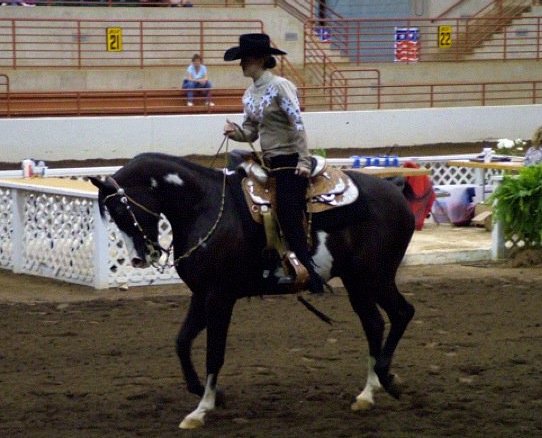
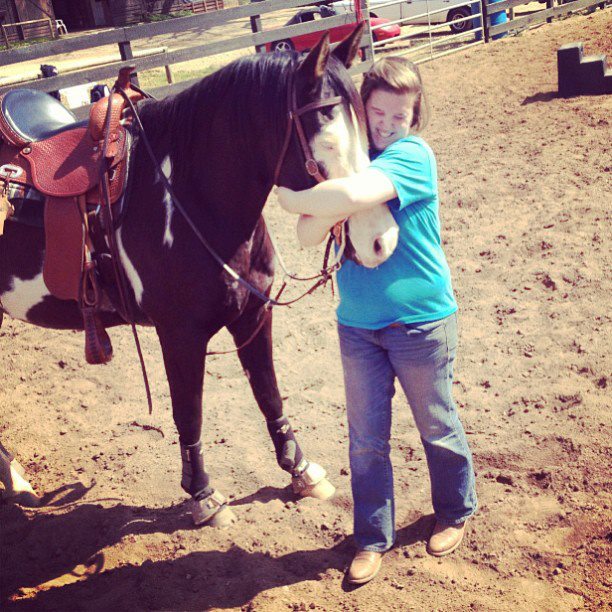
He was half Arabian, half pinto — black and white, like he’d been painted by someone who wanted to make a point. And he had two blue eyes. Not brown like most horses. Blue. The kind of blue that stopped people cold when they saw them up close for the first time. People would come to the barn and walk past a dozen horses and then stop dead in front of him and say wait, are those—? Yes. They were.
He was mine.
I can’t tell you everything about what it felt like to have a horse of my own. I’m not sure language is big enough for it. But I can tell you that I understood, for the first time, what it meant to be responsible for something that trusted you completely. He didn’t know how young I was or how much I was still figuring out. He just knew me. And he showed up for me every single time.
That’s not nothing. That’s everything, actually.
And then my parents sold the farm.
I was in my early twenties by then. Living on my own, working, paying my bills, trying to survive the way you do when you’re young and the world is suddenly very loud. I didn’t live at home anymore. I didn’t have land. I didn’t have a barn. I had a life that had no room in it for a horse, no matter how much I wanted there to be.
I had to sell him.
I sold him to someone I knew — a friend, someone I trusted to take care of him. And I told myself that was enough. I told myself it was the responsible thing, the mature thing, the only thing I could have done given the circumstances.
I still tell myself that.
I just also know that I have never fully stopped grieving it. There are heartbreaks that don’t have tidy endings, and you learn to carry them carefully and not press on them too long because they still hurt in the specific way that only loss of something irreplaceable can hurt. Selling Twister is one of those. I did what I had to do. I wish every single day that I hadn’t had to.
What I kept was the saddle.
Ten Years in a Blanket
I want you to understand something about that saddle.
I didn’t just hang onto it the way you hang onto a box of old photos — shoved in a corner somewhere, half forgotten. I kept it wrapped in blankets. I kept it clean. I kept it polished. And I moved it with me. Every single time I moved — and I moved a lot — the saddle came with me, carefully wrapped, carefully protected.
Here is what my twenties actually looked like: I got things, and then I lost them.
I bought my first house at twenty. My own house, in my own name, which felt enormous and terrifying and like proof that I was going to be okay. I kept the saddle there on a saddle stand, still covered, because I had animals and a chaotic life and I didn’t want it to get ruined. Displayed but hidden. Present but not quite home. I was so proud of that house. And then life shifted on me the way it does when you’re young and still figuring out what you’re building, and I had to sell it. I remember the feeling of handing over those keys — the particular hollow of letting go of the first thing that was ever fully, legally, undeniably mine. I told myself it was just a house. I’m not sure I believed it.
I sold the house and moved into a camper. Which sounds like a step backward and sometimes felt like one, but also taught me things about what I actually needed versus what I thought I needed. I met my husband. I started to understand what it felt like to build something with someone instead of alone. We moved that camper to different places, looking for where we were supposed to land. We moved in with family for a stretch to save money, which has its own particular kind of humbling that I won’t unpack here. We moved into a barn apartment that I will only describe as an experience. We moved into another apartment.
Each time, every time, the saddle came with me.
I would unwrap it, look at it, clean it, check on it like you check on something precious and fragile. And then I would wrap it back up and tell myself: not yet. Not the right place yet.
I think about that pattern now — the getting and the losing, the starting over and starting over again. The house I had to sell. The horse I had to sell. The version of my life I kept thinking I was almost at, and then watching shift again before I could settle into it. My twenties were a long lesson in impermanence. In holding things loosely because nothing seemed to stay.
But I never held the saddle loosely. Not once.
There’s something quietly devastating about that, when I let myself really look at it. I spent over a decade carrying the most important thing I owned without having anywhere worthy to put it. Not because I was ashamed of it. Because I hadn’t built a life yet that had room for what it meant.
I was so far from the life I wanted that the thing I loved most had to stay hidden.
And I kept it anyway. Through every move, every loss, every version of myself I was still figuring out. Because letting go of it would have meant letting go of something I wasn’t willing to release: the belief that I was still the person who earned that saddle. That the farm was still part of me even when nothing in my life looked anything like a farm. That Twister was still mine in some way that mattered, even though I’d had to let him go.
Everything else could be temporary. The saddle was the one thing I refused to lose. So I kept it.
The Wall
My house is not decorated in a western theme. There’s no cowhide, no barn wood, no horseshoe art. I didn’t build a home that looks like where I came from. I built a home that looks like who I am now — with my husband, in the life we’re making together, with land somewhere on the horizon.
Except for one thing.
There is a saddle mounted on the wall in my living room. Old. Worn. Mine.
When we moved in and I finally had walls that belonged to me — really belonged to me, in a home that felt permanent in a way nothing had in a long time — it was one of the first things I pulled out of storage. After ten years wrapped in blankets, I brought it out, looked at it, cleaned it one more time, and put it on the wall where I could see it every day.
Not as decoration. Not as a theme. As a declaration.
I won’t lie to you: I cried a little. Not sad crying, not exactly. The kind of crying that happens when something you’ve been holding very tightly for a very long time finally gets to be what it was always supposed to be. The kind of crying that feels like relief and grief and gratitude all at once.
That saddle is my dad handing it to me and saying you belong here. It’s every ice storm we went out into half-asleep. It’s Twister’s blue eyes stopping strangers cold in a barn doorway. It’s fifteen years of not letting go even when I had nowhere to put what I was holding. It is finally on the wall where I can see it.
Neither of us is hiding anymore.
What the Farm Made
The trainer called me a prima donna when I was eight years old. She wasn’t wrong. I was sensitive, particular, difficult in ways I didn’t have words for yet.
But the farm took all of that and put it to work. It didn’t make me less sensitive — it made me someone who could be sensitive and still get up and go out into the ice storm. Someone who feels things deeply and still does the hard thing. Someone who carries something carefully through fifteen years of losing everything else because she knows exactly what it’s worth.
I didn’t know that’s who I was becoming while it was happening.
But the saddle knew. I think that’s why I kept it. Not out of sentimentality, not out of stubbornness, but because some part of me understood that the saddle was keeping score when I wasn’t. Every time I unwrapped it and wrapped it back up, I was making a quiet promise to myself: you’re not done yet. You’re not finished becoming who you’re supposed to be.
The goal — our goal, as a family — is land. Horses again. The real version, not the Saddle Club fantasy I arrived with as a little kid, but the actual thing: early mornings, hard work, boots by the door, a phone that might ring at any hour because something needs you and you just get up and go. Maybe that saddle comes off the wall one day and goes back to work. Maybe one day I find a horse with blue eyes and I let myself have that again.
I don’t know yet. But I know this:
My twenties were about getting things and losing them. The house. The horse. The life I kept almost having. I held things loosely because I had to, because nothing was permanent, because survival required not gripping too tight.
I gripped the saddle anyway. Through all of it. Through the selling and the moving and the starting over. Through the camper and the barn apartment and every temporary place that wasn’t home yet. I carried it carefully, kept it clean, kept it waiting.
And now it’s on the wall. In a home that is actually mine. In a life that is actually stable. In a place where I can look at it every single morning and feel the full weight of how far I’ve come.
That’s not decoration. That’s a reckoning.
The saddle is on the wall. I put it there on purpose.
And I’m still here.


Leave a Reply